
Fragmented ownership
No single structural map of who owns, controls and benefits.
A wealth architecture built from six generations of practice. Not a product. Not a stand-alone structure. A methodology for families whose wealth has become too interconnected to plan one piece at a time.


Tolani Flow® was earned across generations of real decisions, real losses and real rebuilds. In 2018, what had existed as family practice was formalised into a framework that could be documented and tested.
The framework is designed around four recurring concerns of globally mobile families: how to preserve confidentiality without compromising compliance, how to consolidate a fragmented financial world, how to retain appropriate control and governance, and how to make continuity possible across generations.
A company here. A trust there. Separate custodians, different tax residences, a future liquidity event, and a succession plan designed at another point in the family’s life. Individually reasonable pieces can still produce a fragile whole.
No single structural map of who owns, controls and benefits.
Multiple jurisdictions, custodians and entities create administrative and disclosure complexity.
Legal documents, ownership and family expectations can produce different outcomes.
Private or illiquid wealth meets obligations at the wrong moment.
Specialists solve separate pieces without one shared architecture.
Critical information depends on one founder, family member or adviser.
The instruments change by jurisdiction. The order of thinking should not.

Map assets, ownership, entities, tax residences, reporting, liquidity and succession before proposing another structure.
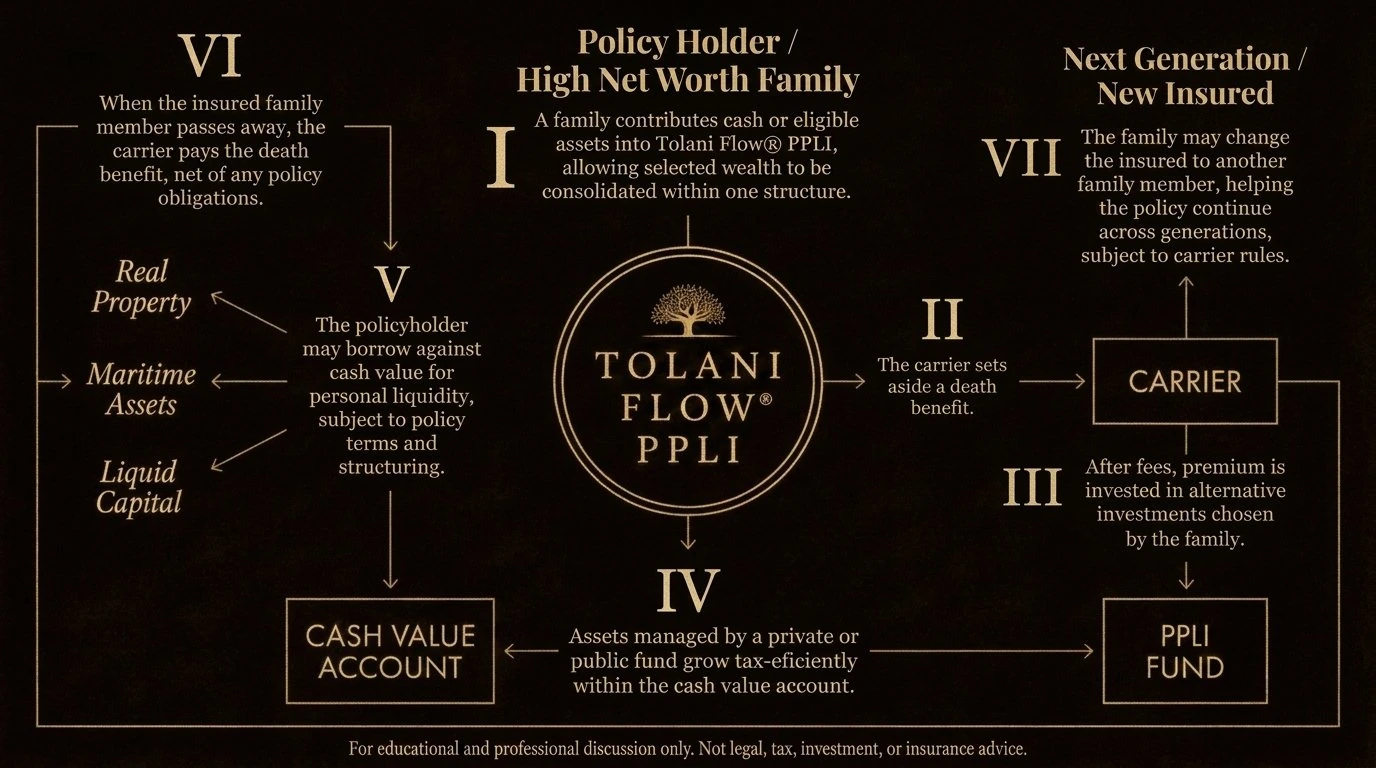
Trusts, foundations, companies, investment mandates and insurance may each play a role. The objective is one coherent design, not one universal product.

Review liquidity, succession, insured persons, governance and documentation as laws, residences and family leadership evolve.
Tolani Flow® coordinates the family’s existing world: family office, trustee, lawyer, banker, investment manager, holding structures and insurance where appropriate. The objective is coherence, not novelty.

The original Tolani Flow® material places Private Placement Life Insurance at the centre of many qualifying architectures because a policy can combine insurance, an institutional investment mandate, liquidity mechanics and succession features in one documented structure.
The family office nevertheless treats those outcomes as questions to test, not promises to assume:
The source framework describes potentially significant tax, estate, privacy and liquidity benefits. Actual outcomes are jurisdiction-, carrier-, policy- and fact-specific and require advice from the relevant qualified professionals.
Open the 2026 research paper →Family members, assets and structures spanning multiple jurisdictions.
Existing governance that needs a coordinated ownership or insurance layer.
Founders approaching succession, liquidity events, ownership transition or heir equalisation.
Lawyers, trustees, bankers and advisers who need one shared architecture to test together.
A deeper examination of Private Placement Life Insurance as a wealth-architecture instrument, including policy mechanics, investment structure, liquidity, succession and the compliance questions that have to be tested in each jurisdiction.
Access the white paper →